They Might Have Just Uncovered Scotland's Oldest Tartan

When we think of Scotland, something that comes to mind is tartan. Plenty of garments - particularly kilts - utilize this patterned cloth in the country. However, do you know how long the Scots have favored this material? Supposedly, their earliest use of it is dated around the 3rd or 4th century CE.
Unfortunately, tartan that existed as far back as this isn’t exactly common today. However, that doesn’t mean there aren’t any historical pieces available anymore. One piece on display at V&A Dundee has been around for centuries, with new research suggesting that it could be Scotland’s oldest tartan ever found.
A piece of tartan was discovered in a peat bog in Scotland
In the 1980s, a piece of tartan was discovered in the Scottish Highlands. Referred to as the Glen Affric tartan because of where it was located, the material had reportedly been there for centuries. Typically, if something like this is exposed to the elements for hundreds of years, it will erode away into nothing. However, the tartan was apparently kept safe by a peat bog, which provided the cloth with a low-oxygen environment. Although the material still shows signs of wear and tear, it’s in a far better condition than it could have been in another part of the Scottish Highlands.
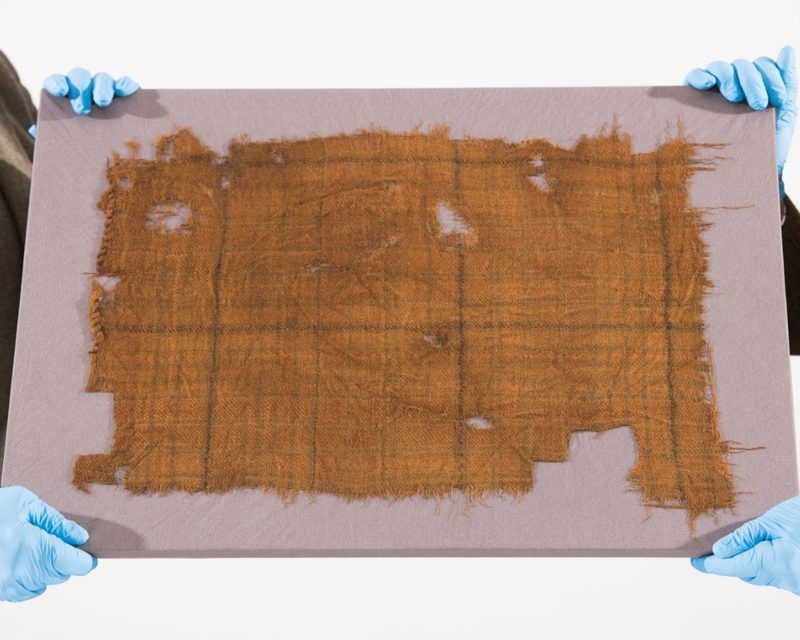
Dye analysis and carbon dating help to pinpoint the tartan’s origin
When the tartan was discovered in the peat bog, it was clear that it hadn’t been dropped there a few days earlier. The material was a piece of history, although precisely how old it was initially eluded scientists. Thankfully, the experts have since managed to determine the age through dye analysis and radiocarbon testing. The former made it clear that the cloth was created no later than the 1700s because there were no traces of semi-synthetic or artificial materials. The latter pushed its origins back even further, revealing that it was likely produced sometime in the 16th century. So, it could well be 500 years old.
The tartan was likely part of an “outdoor working garment”
Luckily, it’s not just the rough age of the tartan that experts have identified. They’re also confident that the material was likely used as an “outdoor working garment” rather than for someone of high status. Apparently, this is because of the “rustic nature of the cloth.” That just makes the existence of this tartan today even more significant, as it’s not something that anyone would have thought to preserve hundreds of years ago. Although historical royal clothing is still few and far between past a certain point, it’s more common than the attire of an average person. So, this is a very special discovery indeed.

It’s believed to be the oldest piece of “true tartan” still around
Now that the experts believe they’ve identified the origins of this tartan, it’s believed to be the oldest example of this material still around today. Technically, there is a piece of tartan that’s older, as it reportedly stems from the third century. Known as the Falkirk tartan, the scrap was discovered in a pot alongside Roman coins. However, according to Peter MacDonald of the Scottish Tartans Authority, this isn’t “true tartan.” The piece from the 3rd century reportedly has a simpler pattern and was made with undyed yarn, hence why it’s more contentious than the Glen Affric tartan.
Without a time machine, discoveries like this are the strongest connection that we have to life in the past. We wouldn’t have expected a piece of tartan from 500 years ago to still be around today. Still, thanks to the wonder of nature, we have this scrap of history to treasure for many years to come.
You May Also Like
 Society
Stories of Choosing a Different Kind of Success
 Careers
The Unexpected Joy of Career Reinvention
 Society
How People Found Community After Moving Abroad